Save Up to
20%
Thank you for visiting, save on your next order with the code
WELCOME20
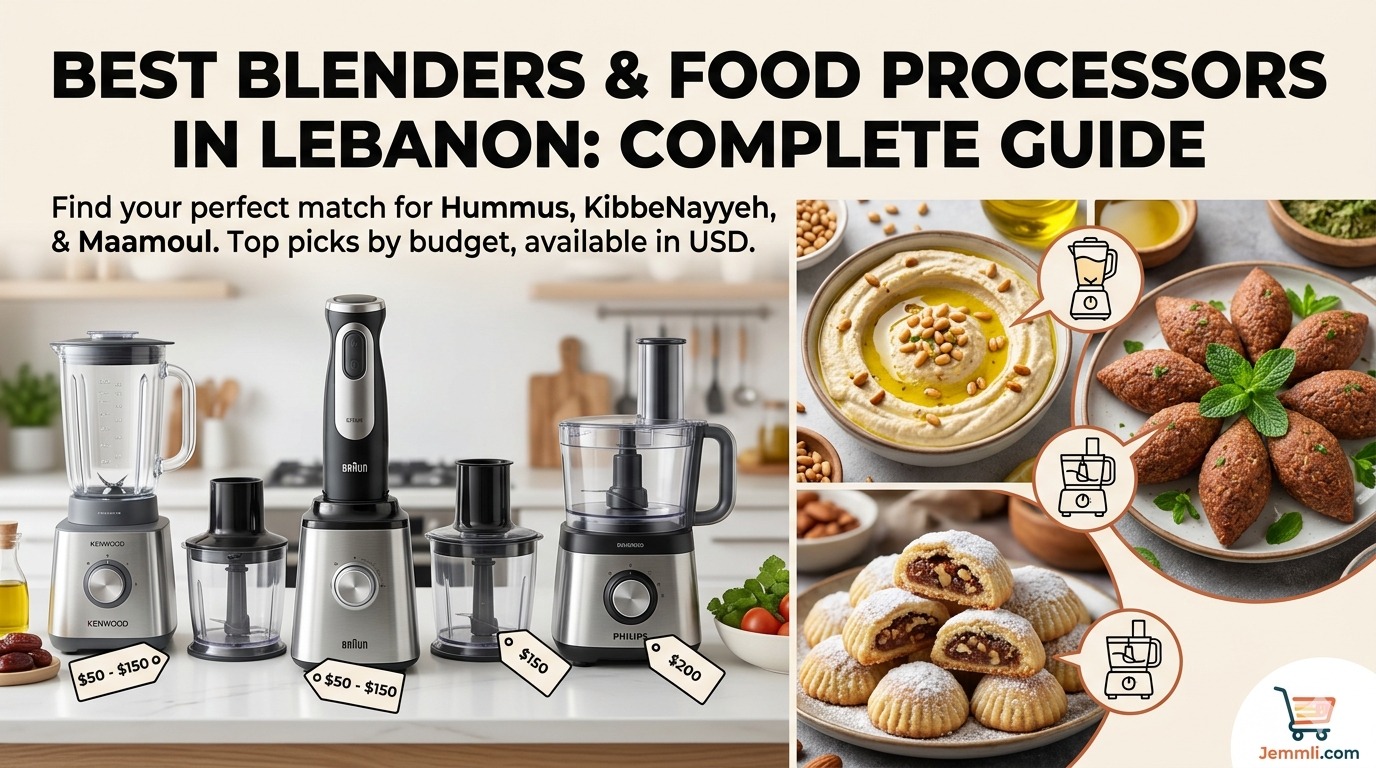
Ask any Lebanese home cook what separates a good hummus from a great one, and the conversation almost always circles back to the blender. Not the recipe — the equipment. The same goes for kibbeh nayyeh, where the texture depends entirely on how finely and evenly the meat and bulgur are processed, and for maamoul dough during Eid season, when a tired hand-kneading session can be replaced entirely by the right machine in under two minutes.
This is exactly why choosing between a blender, a food processor, or a combo unit isn’t a trivial decision in a Lebanese kitchen — it directly affects the dishes that matter most. This guide breaks down the real differences between these appliances, matches them to the specific Lebanese recipes they handle best, and recommends top picks across different budgets, all with honest USD pricing for the Lebanese market in 2026.
Before getting into specific products, it’s worth clarifying something that trips up a lot of buyers: blenders and food processors are not interchangeable, even though marketing sometimes blurs the line. Each is built for a different kind of work, and Lebanese cooking regularly demands both.
A blender uses a tall, narrow jar with blades at the bottom, designed to pull ingredients down into the blade path using liquid as a medium. This makes it the right tool for smoothies, juices, soups, and — critically for Lebanese kitchens — silky-smooth hummus, tahini sauce, and labneh dips. A powerful blender can also crush ice for cocktails or frappés, something a food processor generally cannot do well.
The key spec to watch for is motor power, typically between 500W and 1,500W for home units. For genuinely smooth hummus (no grainy chickpea skins left behind), you want at least 700–800W with sharp, well-designed blades.
A food processor uses a wide, shallow bowl with interchangeable blades and discs, designed for chopping, slicing, shredding, and kneading. This is the appliance for kibbeh nayyeh — where you need the meat and soaked bulgur processed to a fine, even paste without turning into liquid — and for maamoul dough, where a dough blade kneads butter, semolina, and flour into the right consistency in a fraction of the time hand-kneading takes.
Food processors typically range from 500W to 1,000W, and bowl capacity matters more here than in blenders — a 2.5–3 liter bowl is the minimum for processing a usable batch of kibbeh nayyeh or a full maamoul dough recipe for a holiday gathering.
Several manufacturers now offer combo units — a single motor base with both a blender jar and a food processor bowl attachment. These make sense for households with limited counter space who don’t need professional-grade performance in either function. The trade-off is that combo units generally underperform dedicated machines in both categories, though the gap has narrowed considerably with recent models.
For households that need a reliable everyday blender without heavy investment, the Black+Decker BL2010 covers the basics well. At 550W, it handles smoothies, juices, and basic dips competently, though it will struggle with very thick mixtures like a dense hummus without added liquid. Two speed settings plus a pulse function give enough control for most daily use.
Best for: Smoothies, juices, and light kitchen tasks on a tight budget.
A compact food processor in the 500–600W range, useful for smaller households that occasionally need to chop herbs, mince garlic, or process small batches of kibbeh nayyeh. The bowl capacity (typically 1–1.5 liters) is too small for large family-batch cooking, but for a couple or small household, it’s a practical entry point.
Best for: Small households with occasional chopping and mincing needs.
This is where blenders start delivering genuinely smooth Lebanese hummus and tahini sauce. At 900W with a ProBlend system and durable stainless steel blades, the Philips Daily Collection handles chickpeas, ice, and frozen fruit without straining. The 2-liter jar is generously sized for batch-cooking hummus for a family gathering, and the machine is quiet enough not to wake a sleeping household at 7am.
Best for: Households serious about smooth, restaurant-quality hummus and dips at home.
KitchenAid’s reputation in Lebanese kitchens is well earned, and their compact food processor justifies it for kibbeh and dough work specifically. The sharp, well-balanced blade processes meat and bulgur into an even, fine texture — the single most important factor in good kibbeh nayyeh — without the mixture turning watery or pasty. The dough blade attachment also handles maamoul dough capably, kneading a full batch in under 90 seconds.
At 400W, it’s not the most powerful unit on this list, but food processors rely more on blade design and bowl geometry than raw wattage, and KitchenAid gets this balance right.
Best for: Households that make kibbeh nayyeh and holiday maamoul regularly and want consistent, professional-level results.
For households wanting one machine that handles both jobs reasonably well, the Tefal Blend & Chop combo offers a blender jar and a 1.5-liter chopper bowl on a shared 800W motor base. It won’t outperform dedicated machines in either category, but for apartments with limited counter and storage space, it’s a sensible middle ground.
Best for: Smaller kitchens that need both functions but lack space for two separate appliances.
For households that take their cooking seriously, the Vitamix E310 represents a genuine step up in capability. At 1,200W with aircraft-grade stainless steel blades, it processes anything — ice, frozen fruit, raw vegetables, whole chickpeas with skins — into completely smooth textures in seconds. For a Lebanese kitchen, this means hummus and tahini sauce with a silkiness that’s difficult to achieve with lower-powered machines, plus the versatility to make soups, nut butters, and even grind grains.
The variable speed dial and pulse function give precise control, and the 64-ounce container is large enough for serious batch cooking. It’s a serious investment, but for someone who blends daily and values consistent professional results, the difference is noticeable from the first use.
Best for: Serious home cooks and households that blend daily across a wide variety of recipes.
For households where holiday baking — maamoul, ka’ak, and other traditional sweets — is a serious annual undertaking, a KitchenAid stand mixer with the optional food processor attachment is the most versatile investment available. The stand mixer alone handles large-batch dough kneading (maamoul, bread, cake batters) far more capably than handheld food processors, while the attachment adds chopping and slicing functionality when needed.
This is less a single-purpose buy and more a long-term kitchen investment — KitchenAid stand mixers are known to last decades with proper care, and many Lebanese households pass them down between generations.
Best for: Households that bake and prepare large-batch holiday foods regularly, especially during Eid and other festive seasons.
It’s worth being specific here, because Lebanese cooking has particular demands that generic buying guides tend to miss.
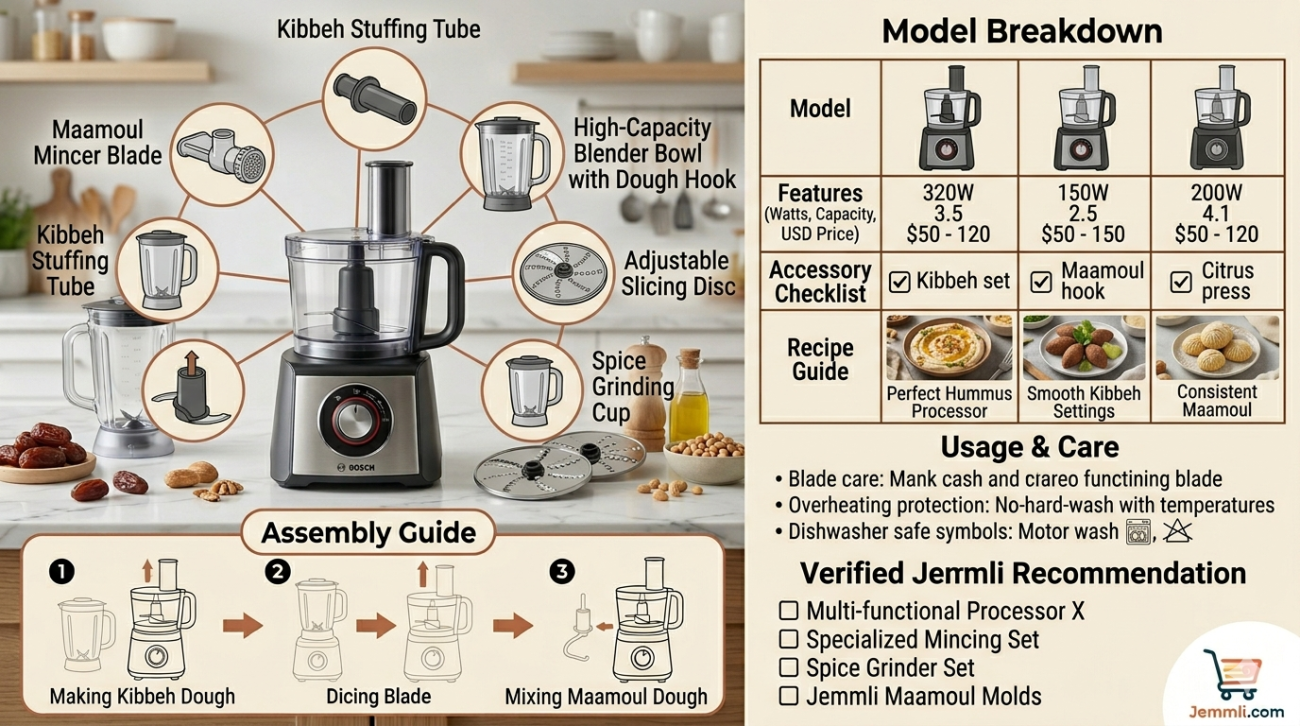
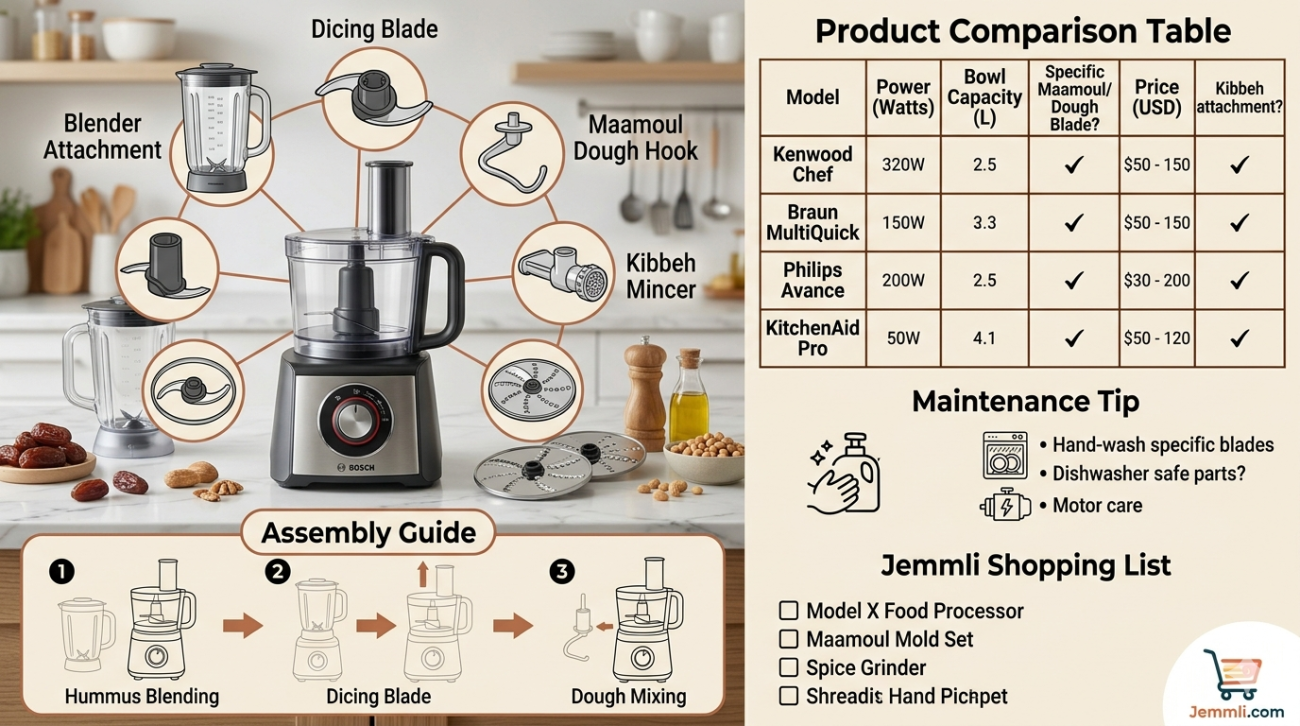
For hummus, the priority is a powerful blender (700W minimum) with a jar wide enough at the base to keep ingredients moving — narrow-bottomed jars cause chickpeas to get stuck rather than circulate properly. For kibbeh nayyeh, a food processor with a sharp, well-balanced blade matters more than raw power — you want an even, fine texture without the mixture breaking down into liquid. For maamoul dough, either a food processor with a dedicated dough blade or a stand mixer with a dough hook handles the kneading; a standard blender cannot do this job at all.
For tabbouleh prep — finely chopping parsley, mint, and tomatoes — a food processor with a sharp chopping blade saves considerable time over hand-chopping, though many traditionalists still prefer the knife for the specific texture it produces.
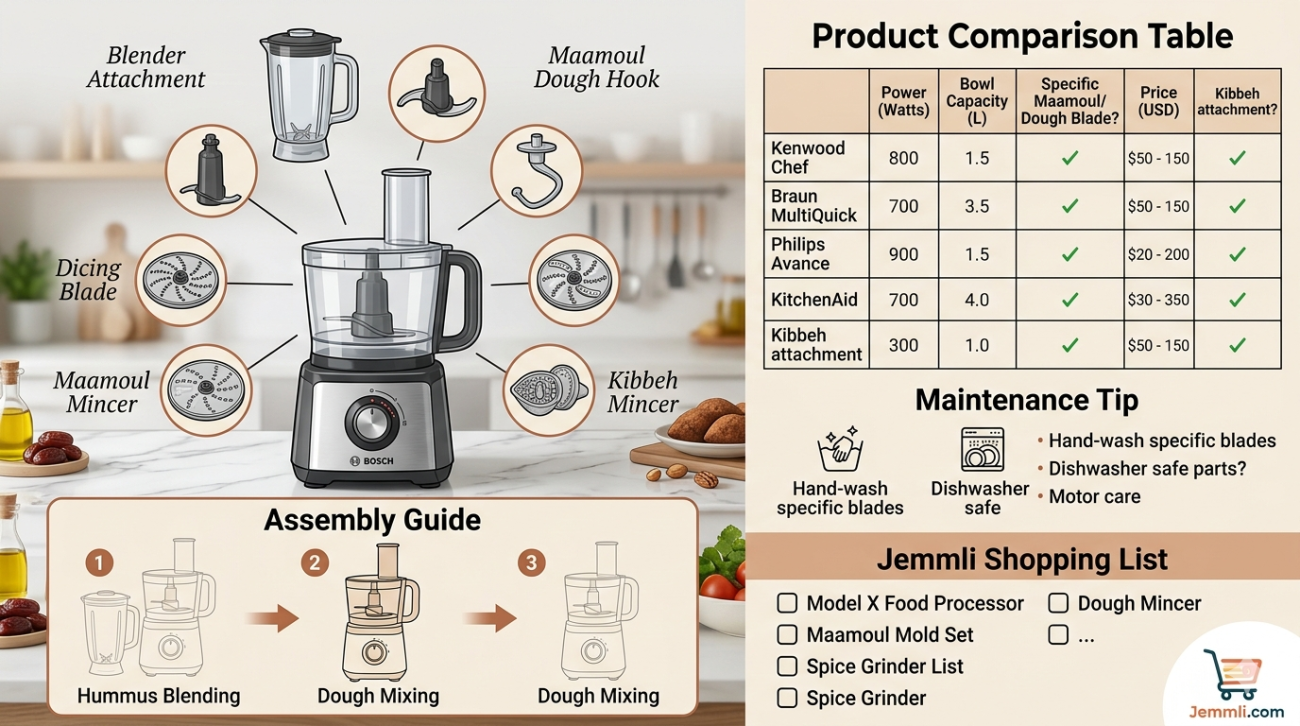
Jemmli carries a full range of both blenders and food processors across all budget tiers, with transparent USD pricing and genuine branded products. Browse the blenders category for smoothie and hummus-focused machines, or the food processors category for chopping, mincing, and dough work.
Not reliably. Blenders are designed around liquid movement and tend to over-process meat into a paste or leave it unevenly chopped, since there’s no liquid medium to help circulation. A food processor’s wide, shallow bowl and sharp chopping blade handle the texture requirements of kibbeh nayyeh far more accurately.
Look for at least 700–800W of motor power and a wide-based jar, since narrow jars cause chickpeas to get stuck rather than blend evenly. The Philips Daily Collection (900W) and Vitamix E310 (1,200W) both deliver consistently smooth, restaurant-quality hummus without graininess.
For households that cook a varied Lebanese menu regularly — hummus and dips alongside kibbeh nayyeh and holiday dough — yes, owning both delivers noticeably better results than relying on a single combo unit. If budget or space is limited, a quality combo unit is a reasonable middle ground, though it will underperform dedicated machines in demanding tasks.
Reliable mid-range food processors suitable for kibbeh and dough work generally fall between $100 and $200 in Lebanon. Entry-level mini processors start around $40–$55 but are better suited to small chopping tasks than serious batch cooking. Premium options with stand mixer attachments start around $350.
For food processors, aim for at least a 2.5–3 liter bowl capacity to comfortably process a full batch of kibbeh nayyeh or maamoul dough for a gathering. For blenders, a 1.5–2 liter jar handles family-size batches of hummus or smoothies without requiring multiple cycles.
The right combination of blender and food processor transforms how efficiently a Lebanese kitchen runs — turning what used to be twenty minutes of hand-kneading or chopping into a two-minute task, with results that are often more consistent than manual preparation. Whether you’re after silky hummus, perfectly textured kibbeh nayyeh, or stress-free maamoul dough ahead of Eid, there’s a machine on this list suited to your kitchen and your budget.
Explore the full range of blenders and food processors in Lebanon at Jemmli, where genuine products and honest USD pricing make the decision easier. Your hummus — and your hands — will thank you.
No account yet?
Create an Account