Save Up to
20%
Thank you for visiting, save on your next order with the code
WELCOME20

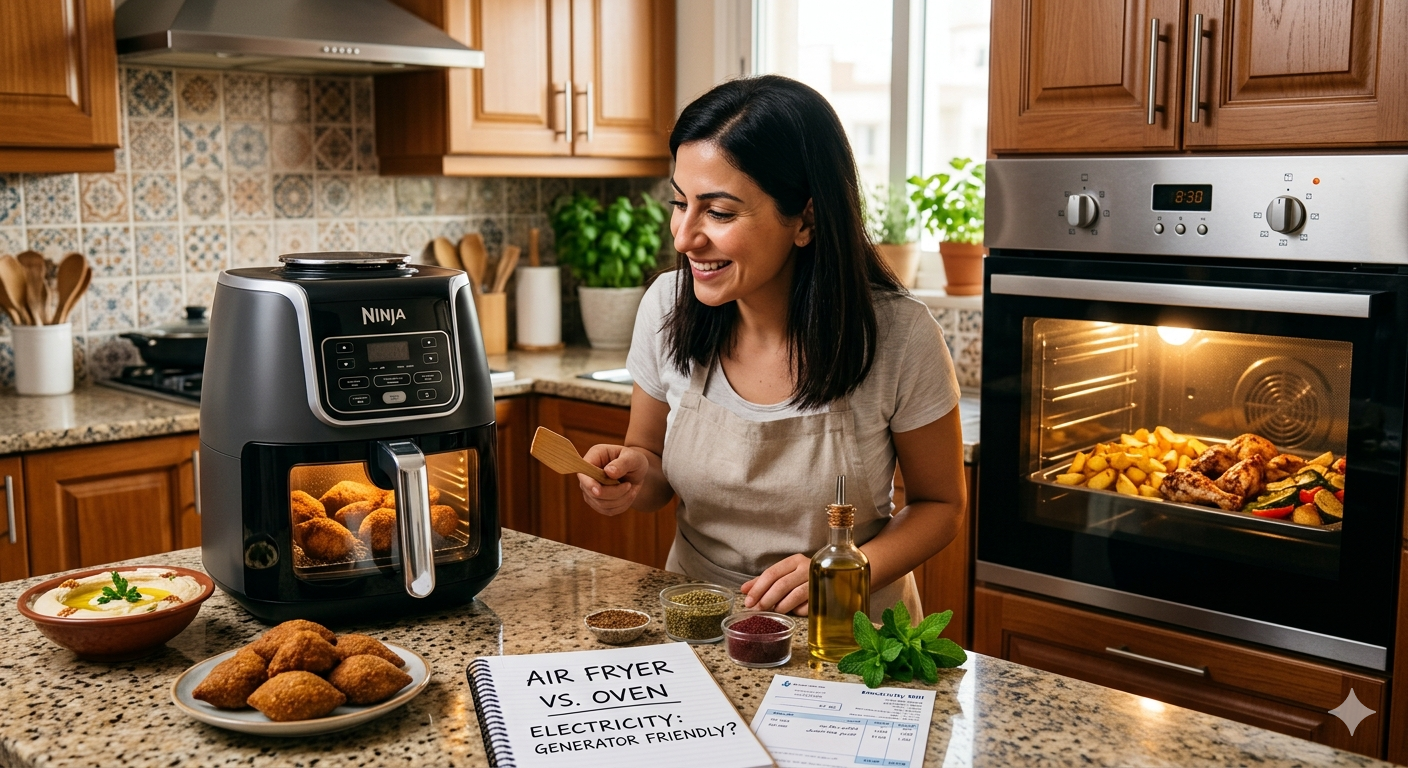
Every Lebanese household has a moment of reckoning with the electricity bill. Whether it’s the EDL invoice, the generator subscription fee, or both arriving in the same week, the question of which appliances are actually worth running — and when — has become a genuine part of daily kitchen planning. That’s the real context behind the air fryer vs. oven debate in Lebanon. It’s not just about cooking preference. It’s about power consumption, generator hours, and getting a hot meal on the table without blowing through your amperage.
This comparison is built specifically for Lebanese households — the ones juggling scheduled cuts, shared generator lines, and the very real arithmetic of what a kitchen appliance costs to run per hour. By the end, you’ll have a clear, practical answer to which appliance makes more sense for your home, your cooking style, and your electricity reality in 2026.
Before getting into the details, here’s the honest summary: the air fryer wins for most Lebanese households — especially those relying on generator power for part of the day. But the oven isn’t obsolete. There are specific cooking situations where a full-size electric oven simply does things an air fryer cannot. The goal here is to help you understand exactly where each appliance earns its place.
This is where the difference is most stark — and most relevant to life in Lebanon.
A standard electric oven in Lebanon draws between 2,000W and 3,500W depending on size and whether it uses both the top and bottom heating elements simultaneously. Run it for an hour at full power and you’re consuming 2–3.5 kilowatt-hours of electricity. On a private generator, that’s significant. Many household generator subscriptions in Beirut run at 5 or 10 amperes — at 220V, that translates to roughly 1,100W and 2,200W of available power respectively. A full-size oven on a 5-ampere subscription simply trips the line.
An air fryer, by contrast, typically draws between 1,200W and 1,800W — and because it preheats in under three minutes (versus 10–15 minutes for a conventional oven) and cooks faster, the actual energy consumed per meal is considerably lower. A chicken that takes 90 minutes in an oven might take 35–40 minutes in an air fryer. That’s not just time saved — it’s a meaningful reduction in your air fryer electricity consumption in Lebanon, especially when generator hours are precious.
For a household on a 5-ampere generator line, a mid-range air fryer at 1,500W is often the only viable hot-cooking option during power cuts. For a 10-ampere line, you have more flexibility — but the air fryer still wins on efficiency.
Speed is one of the air fryer’s clearest advantages. The compact chamber heats instantly, and the high-velocity fan circulates hot air around food from all directions simultaneously. A conventional oven relies on radiant heat from elements, which takes longer to penetrate food evenly.
Practical Lebanese cooking comparisons make this concrete:
The pattern is consistent: air fryer cooking time runs at roughly 40–50% of conventional oven time for most everyday dishes. When you’re cooking after a long workday or trying to get lunch ready before the generator cuts off, that difference is felt.
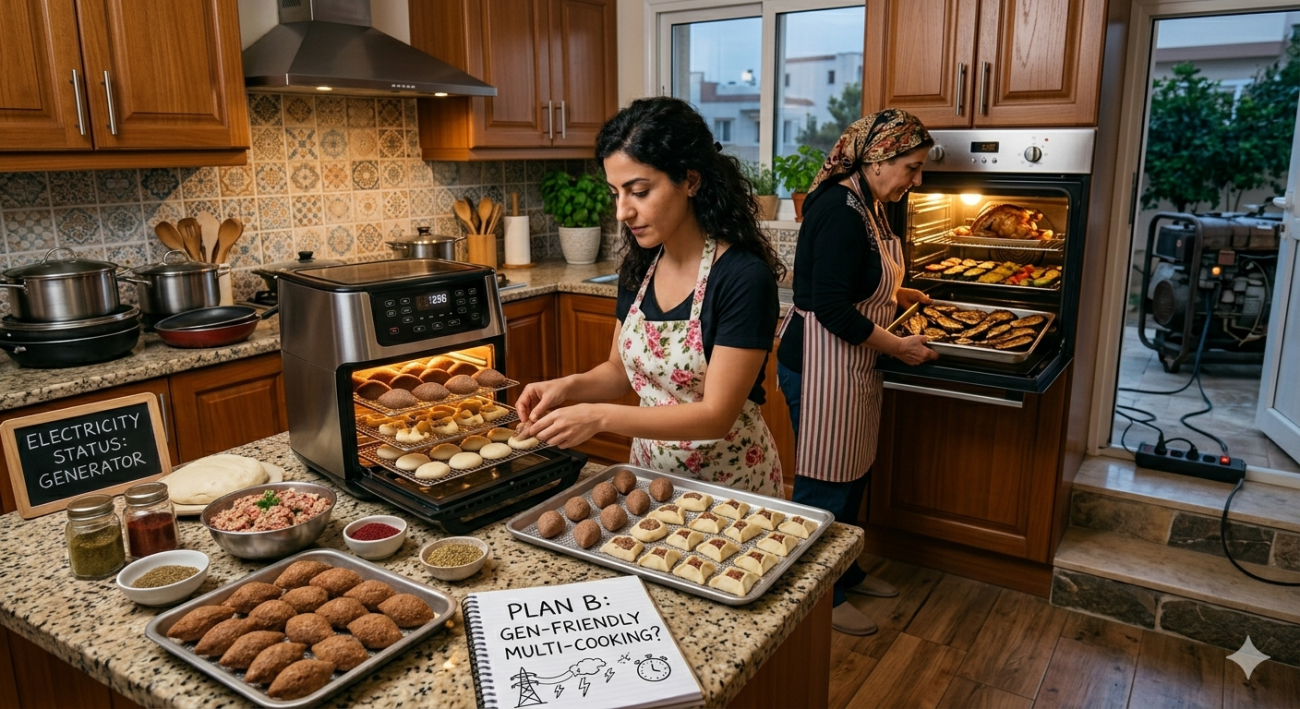
The air fryer produces results that a conventional oven genuinely struggles to replicate for certain food types. Anything that benefits from crispiness — fried kibbeh, falafel, samboussek, potato wedges, breaded chicken, arayes — comes out of an air fryer with a crackling exterior and a moist interior. The rapid airflow creates a Maillard reaction (the browning process responsible for flavor and texture) more aggressively than a standard oven, even at equivalent temperatures.
For reheating leftovers, the air fryer is exceptional. Lebanese homes almost always have day-old food to revive — and where a microwave turns yesterday’s kibbeh into a rubbery disappointment, an air fryer restores it to near-fresh texture in five minutes.
Oil-free cooking is another meaningful advantage. Traditional Lebanese frying uses significant amounts of oil, particularly for falafel, kebbeh balls, and batata harra. Air frying reduces this to a light brush or spray — achieving results that, in blind taste tests, most home cooks find comparable to deep-frying for everyday meals.
The oven earns its place for volume and certain cooking styles. If you’re making a large tray of kibbeh bil sanieh, a full rack of lamb, multiple trays of ma’amoul for Eid, or baking bread — the oven’s larger cavity and consistent ambient heat are genuinely superior. You cannot bake a proper Lebanese loaf or a full holiday tray of baklawa in a standard air fryer.
The oven also handles slow roasting better. A shoulder of lamb cooked low and slow for four hours develops a depth of flavor and tenderness that a compact air fryer simply can’t replicate in the same way. For these occasions — weekly big lunches, holiday cooking, large family gatherings — the electric oven remains the right tool.
Here’s the frame that matters most in the Lebanese context: what can you actually use during generator hours?
For most households with a standard generator subscription, running a full electric oven is either impossible (trips the line) or impractical (consumes your daily amperage allowance on a single meal). The air fryer, with its lower wattage draw and shorter cooking windows, is designed for exactly this reality — even if it wasn’t designed with Lebanon specifically in mind.
A 1,500W air fryer running for 20 minutes consumes 0.5 kWh. A 2,500W oven running for 45 minutes consumes 1.875 kWh. Over a month of daily cooking, that gap becomes financially significant — particularly with the cost of private generator electricity in Lebanon running between $0.20 and $0.40 per kWh depending on your provider and neighborhood.
Power cut cooking tips for Lebanon: schedule your air fryer meals for peak generator hours, use it for the main protein dish, and handle cold prep (salads, dips, bread) without any appliance load. Many Lebanese households have found that an air fryer effectively replaces the oven for 80% of weekday cooking — reserving the oven for weekends and special occasions when power conditions allow.
Electric ovens in Lebanon range from around $150 for basic freestanding models to $400+ for larger, higher-end units. They also require a dedicated electrical circuit in most cases, and installation adds to the upfront cost.
Air fryers in Lebanon start at roughly $70–$80 for reliable mid-range models and top out around $150 for large-capacity premium options. No installation is required — plug in and start cooking.
For a household that’s genuinely debating between investing in a quality air fryer or upgrading their oven, the air fryer offers a lower entry cost, lower running costs, and — for most everyday Lebanese meals — comparable or better results on the specific dishes cooked most often.
If you already own a functioning oven, the air fryer is an additive purchase, not a replacement. But if you’re equipping a new apartment or replacing an aging appliance, the best kitchen appliance for Lebanon’s power conditions is almost certainly the air fryer first, oven second.
There’s no need to be absolutist here. The oven makes clear sense if:
Outside of these scenarios, the air fryer covers daily Lebanese cooking needs with less electricity, less waiting, and less cleanup.
If you’re ready to add an air fryer to your kitchen — or explore your oven options — Jemmli carries both categories with transparent USD pricing and genuine products. Browse air fryers in Lebanon or compare electric ovens to find what fits your household’s needs.
Yes — significantly. An air fryer uses 30–50% less electricity per meal than a conventional electric oven, thanks to lower wattage draw and much shorter cooking times. For households on generator power, the saving is even more pronounced because shorter run times mean less generator consumption per cooking session.
For most weekday cooking, yes. Everyday Lebanese dishes — falafel, kibbeh, samboussek, grilled meats, roasted vegetables, reheated leftovers — all work excellently in an air fryer. Where you’ll miss a full oven is for large holiday trays, bread baking, and slow-roasted dishes. If your cooking is primarily weekday family meals, an air fryer handles it.
A microwave typically draws 700–1,200W but is only used for 2–5 minutes at a time, making its per-use energy consumption very low. An air fryer draws more power but replaces the oven for full cooking, not just reheating. For actual cooking (not just warming), the air fryer is dramatically more efficient than the oven. For pure reheating of small portions, a microwave is slightly more efficient — but the air fryer produces vastly better food quality.
Models at or under 1,500W are safest for standard 5-ampere generator subscriptions. The Tefal Easy Fry Precision (1,500W) and the Philips Essential Air Fryer (1,400W in some models) are both solid choices. Always confirm the wattage on the specific model before purchasing.
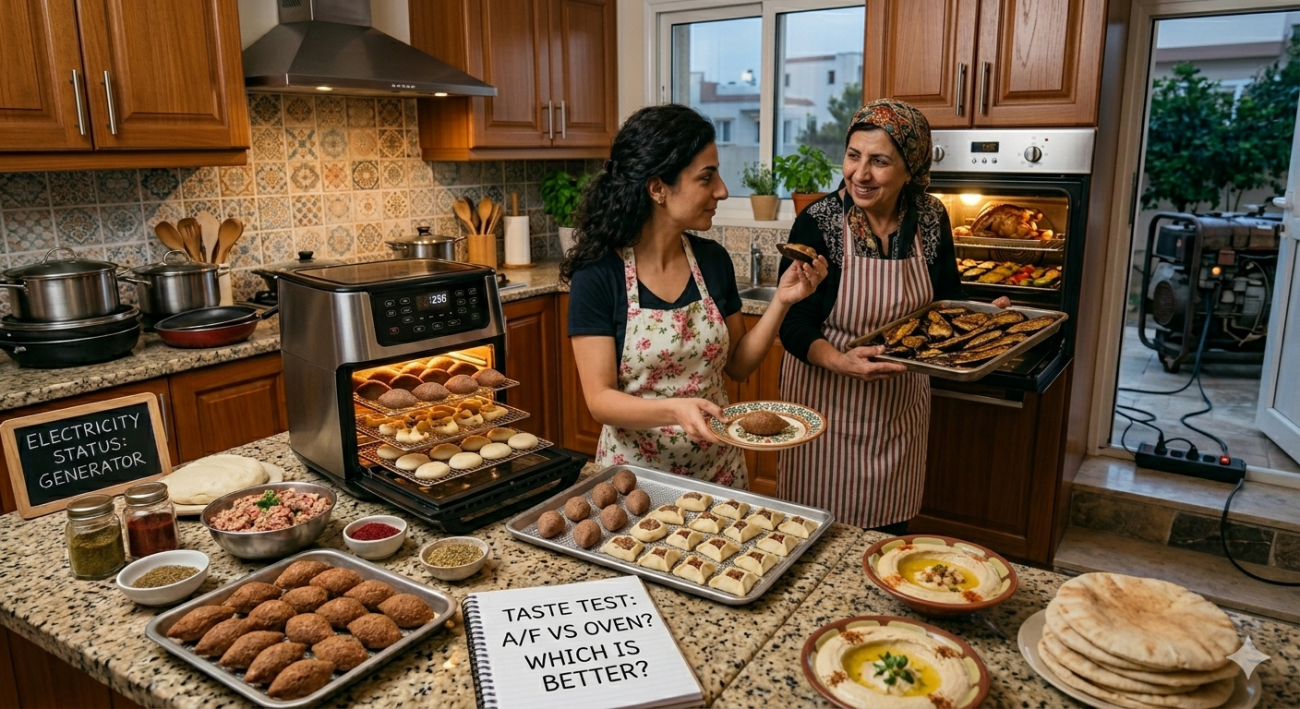
For a family that cooks varied Lebanese food — both everyday meals and holiday dishes — yes, owning both makes sense. Use the air fryer daily for efficiency, and reserve the oven for larger occasions. Many Lebanese households now operate exactly this way, treating the air fryer as the daily workhorse and the oven as the weekend appliance.
The air fryer vs. oven debate doesn’t have a universal answer — but it does have a Lebanese one. For households navigating scheduled power cuts, generator limitations, and the rising cost of electricity, the air fryer is the more practical, more efficient, and often more capable everyday appliance. The oven remains relevant for volume cooking and specific techniques — but for 80% of what Lebanese families cook on a regular basis, the air fryer does it faster, cheaper, and often just as well.
If you’ve been sitting on the fence, 2026 is the year to make the call. Your electricity bill — and your family’s dinner schedule — will both thank you for it. Ready to find the right model? Explore the full range of air fryers available in Lebanon at jemmli.com.
No account yet?
Create an Account